Showing posts with label Patristics. Show all posts

Monday, May 20, 2013

What makes God good?

Whether someone believes in a creator, as Christians do, or he is an atheist, evil is a glaring philosophical problem. It confronts the believer with doubts about the goodness of a god who could make a world filled with starving children. Likewise, suffering confronts the atheist with questions about how to define “evil” and how to confront it.

The earliest Christians were not oblivious to the problem of affirming the goodness of a creator and the constant reality of suffering and evil. They wrestled with the difficulty and purposed a number of responses. 
One response, proposed most famously by Marcion, argued that the god who created the world was to blame for evil but the heavenly father of Jesus released believers from captivity to the trappings of material things turning them instead to the spiritual. This proposal, if I can oversimplify, says, “There is a god responsible for creating evil, he’s the god of the Jews found in the Jewish Scriptures. But that’s not the god we worship in Jesus. In fact, Jesus came to set us free from captivity to that evil god and to worship his loving, kind heavenly father.” 

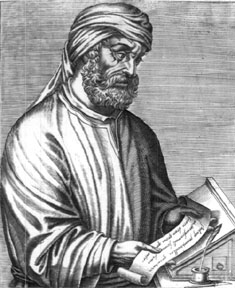
Tertullian, the father of Latin theology pictured above, argued that in his attempt to find a good, kind, loving god, Marcion invented a god that is really no good at all. In his response, Tertullian created a rubric for measuring the goodness of a god (Against Marcion 1.22–25). According to Tertullian, a good god must be eternal, rational, and perfect. Each attribute is aimed as an attack on Marcion’s theology.

Marcion’s solution to the problem of evil was to blame it on the creator thus absolving the heavenly father. But, Tertullian argued that a truly good god could not just arrive on the cosmic scene after creation. From a good God “we shall expect goodness to be perennial and ever-flowing, [. . .] being stored up in readiness with the treasuries of his natural attribute” (Against Marcion 1.22). If a god is truly good, then that goodness has to be on display from the very beginning of time. Otherwise he is only good on a whim, and that’s not really good. If Marcion's god is good, then, where was he when the evil creator did his creative work? Why didn’t he stop it? Why did he wait so long to provide a solution? For a god to be truly good, he has to be eternal.

Marcion’s redeemer releases humans from fleshy living in order to become truly spiritual and non-physical. This kind of salvation is inadequate, according to Tertullian because such a god fails to rescue humanity and settles for an escape from their created existence. Tertullian mocks:
“I should reckon no man more presumptuous than the one who in one God’s water is baptized for another god, who towards one God’s sky spreads out his hands to a different god, bows down upon one God’s soil to a god whose soil it is not, over one God’s bread give celebrates thanksgiving to another.” (Against Marcion, 1.23)
His point is that Marcion’s god is irrational because he fails to redeem humanity and instead offers an escape from the creator god. Such a salvation does not make sense. For Tertullian, a good god must be rational.

Lastly, a good god must be perfect. Similar to the previous critique, Tertullian is referring to a perfect salvation. A salvation of the soul is imperfect, because humans are not just souls. We have bodies, flesh and blood, and so for us to be rescued our bodies must also be saved by a good god. A god that can only save part of us is not a perfect and thus not a good god.

What do you think it means for a god to be “good”? 
This is a crucial question for thinking through the problem of evil. If a “good” god acts like us, is he really good? Or is he just what we want?

Thursday, May 2, 2013

Meeting in the Air (1 Thess. 4:15-17)


In preparation to teach on 1 Thessalonians 4:13–18, I read John Chrysostom’s Homily on the passage. There were lots of interesting insights, but I want to point out only one that I think has significant value for contemporary readers.

John Chrysostom, for those unfamiliar, is one of great “Doctors of the Church” in the East who lived from around 347–407 CE. He was made Bishop of Constantinople against his will in 398 and worked tirelessly to preach the Scriptures to reform the nominally Christian culture in which he found himself. His most enduring legacy is found in his many sermons and exegetical writings. Thankfully, we have a number of writings on Paul’s letters, including a collection of homilies on 1 Thessalonians.

Commenting on 1 Thessalonians 4:15–17, in his eighth homily in 1 Thessalonians, Chrysostom asks an important question: “If he [Christ] is about to descend, for what reason will we be caught up?” Many modern readers fail to ask this question and simply assume that believers “go to heaven.” The imagery here, however, is not of “rapture” (of the Left Behind sort), or final departure to the pie in the sky, but a welcome party for the arrival of Jesus. Chrysostom’s answer to his question about why Jesus comes down and we rise up is quite helpful:

“The reason is honor. For when a king enters a city those in honor go out to meet him, but those condemned remain inside for judgment. When a loving father comes, the children, and those worthy to be children, go out on a chariot in order to see and kiss him, but those having offended him remain in the house.”
The “meeting” that occurs as Jesus comes down and believers go up is a welcome party for Jesus that bestows vindicating honor on the saints. It refers to believers going up to meet Jesus, only to then return to earth for final judgment.

The word “meet” is used in precisely this same way elsewhere in the New Testament. In Acts 28 Paul journeys to Rome to await trial before the Emperor. When Roman Christians hear of Paul’s arrival they leave the city to meet him, with the obvious intention to return with him to Rome. In Jesus’ famous parable of the ten virgins there are five wise virgins who have enough oil in their lamps and five foolish ones who do not. The virgins are waiting to meet the bridegroom only to be taken to the ultimate destination of the wedding banquet. 


Meeting Jesus in the air is, as Chrysostom points out, a vindication of those who know their king (cf. Josephus, JW 7.100–2). They celebrate his arrival by publicly meeting him on the journey down to welcome and honor him.

Monday, January 21, 2013

Learning to Read the Bible from the Ancients

While making my way through Francis M. Young's fantastic book Biblical Exegesis and the Formation of Christian CultureI came across this gem of a quote that strikes me as profoundly true and commonly ignored:


"Early Christian exegesis is best understood by considering the function of literature in the culture of the Graeco-Roman world, and discovering the kind of debates about exegesis that were then current." (p. 169).

This comes in her chapter explaining the hermeneutical division between the Antiochene and Alexandrian schools of exegesis in the fourth century. She suggests that the hermeneutical division parallels the tension between sophists (rhetorical education of Antiochenes) and philosophers (philosophical education of Alexandrians). I am oversimplifying her very nuanced argument, but I have found her case quite convincing.

Too often we think ancients read and thought like we do. This is a call to learn to read again.

Saturday, December 15, 2012

New "Must Read" on Paul's use of Scripture

There are a lot of fantastic books about how Paul used the Jewish scriptures, which is still a fairly recent area of research in NT scholarship. Some "must reads" include Richard Hays's Echoes of Scripture in the Letters of Paul, Francis Watson's Paul and the Hermeneutics of Faith, and Christopher Stanley's Paul and the Language of Scripture. Not to mention the monographs of Dietrich-Alex Koch (Die Schrift als Zeuge des Evangeliums) and J. Ross Wagner (Heralds of the Good News). All of these books were written within the last forty years and two of them written in the last ten years. Each of these studies makes crucial contributions to understanding how Paul employed scripture, but there is a new "must read" that merits serious attention from all interested parties.  

This year at SBL I picked up Matthew Bates's The Hermeneutics of Apostolic Proclamation: The Center of Paul's Method of Scriptural Imagination and I am convinced this book belongs on the same shelf as Hays, Watson and Stanley. I'm not finished with it yet, still a couple chapters left, but I have been impressed at every turn. The book is the revision of Bates' Notre Dame dissertation written under David Aune with examiners John P. Meier and Brian Daley. He offers a truly original contribution that is both ambitious and convincingly argued. 

I plan to offer a full review when I'm finished with the book, but for now I'm officially calling for an SBL panel review with respondents Richard Hays, Christopher Stanley, and Francis Watson. A guy can dream . . . 

tolle lege

Saturday, May 26, 2012

Learning to Read from the Ancients


Jesus often fought about how sacred words should be interpreted. Indeed, his conflict with the Pharisees often concerns how the law should be observed (Mt 9.11-13 || Mk 2.16-17; Mt 12.1-8 || Mk 2.23-28; Mt 12.19-14 || Mk 3.1-6; Mt 15.1-20 || Mk 7.1-23). Likewise, church history is fraught with division over interpretations. One group claims to understand the true meaning of a text against another. Interpretive disagreement continues to divide churches today. 


In light of Jesus’ debates, disputes throughout church history and in the contemporary church, it is important to develop a consistent and logical method of interpretation – a hermeneutic. Most seminaries and Bible colleges are concerned precisely with this training. In her book, Hermeneutics and the Rhetorical Tradition, Kathy Eden traces the development of Christian hermeneutics from the rhetorical tradition of Quintilian and Cicero to early protestant hermeneutics in Erasmus and Philip Melanchthon. Eden is a distinguished classics professor at Columbia University and provides a fascinating study of the development of humanist hermeneutics.


Eden thoughtfully observes that it is in the rhetorical handbooks that one finds the reflection on interpretation that was appropriated by the church fathers. Her first chapter is devoted to works of Quintilian and Cicero showing how these rhetoricians were concerned with the interpretation of texts for legal disputes. There were three main problems that arose in interpretation:

  1. Discrepancy between the letter of the law and the intent
  2. Ambiguity with a particular word or a passage
  3. Contradiction either between two related texts or within a single text

According to Cicero and Quintilian, the solution to these interpretive problems was to learn from Aristotle how to read with “equity” (ἐπιείκεια / aequitas). Equity is the ability to read a text graciously or tolerantly rather than in its “exactness” or “strictness” (ἀκρίβεια). So, Paul exhorts the Corinthians with the “humility and gentleness [ἐπιεικείας] of Christ” (2 Cor 10.1). Equity is a sought after characteristic in a judge (Acts 24.4) or ruler (Josephus, Ant. 12.122; 19.246; Against. Ap. 2.209) and frequently appears in appeals to God as a righteous judge in Hellenistic Jewish literature (2 Macc 2.22; 10.4; Wis 12.18; Bar. 2.27; LXX Dan 3.42; cf. Philo, Mos. 1.198; Virt. 106; Josephus, Ag. Apion 2.214). Equity, then, is an accommodation to a particular need or circumstance rather than a rigorous devotion to the letters themselves.


As a hermeneutical guide from Aristotle, equity aids in solving interpretive problems. An equitable reading allows discrepancies between letter and intention to be resolved by recognizing that written texts cannot take into account every eventuality or circumstance that might fall under their application. Thus, the intention of the law takes precedence when read equitably. Likewise, ambiguity is resolved by reading equitably to accommodate the particular use of a word or passage for a particular circumstance. So equity takes into account the historical and textual (or literary) context of a text. Equity also resolves contradictions by reading the parts of a text in light of the whole text and even the author’s life, again accommodating the particularity of the author.


In her second chapter, Eden shows the same interpretive principles at work in the grammatical tradition of Plato and later Plutarch. Using the poetry of Homer via Platonic allegory, Plutarch describes good reading as a journey home to true knowledge (philosophy). Eden shows that the grammatical texts use the concepts of “suitability” (τὸ πρέπον /decorum) which is “the ability to accommodate the occasion” (Eden, 26). Similar was the concept of “economy” or “order” (οἰκονομία) which was used by the grammarians to refer to the arrangement of the text. Suitability and economy, again, emphasized the same concept as equity among the grammarians – reading a text in light of its particularities.


In her third and longest chapter (pgs 41-63), Eden shows how these same concepts of learning to read a text in light of its particularities were employed by the church fathers Basil of Caesarea and Augustine of Hippo. She convincingly argues that Basil appears to have been influenced significantly by Plutarch in his exhortation to the young on reading. Likewise, she illuminates Augustine’s De doctrina as an example of Christianized hermeneutic from the rhetorical tradition. The last three chapters follow this trajectory in Erasmus (pgs 64-78), Melanchthon (pgs 79-89) and Flacius (90-100).


I first heard about Eden’s fine book in a presentation from a Patristics scholar, Professor Ronald Heine. Dr. Heine was presenting on Origen’s interpretation of Matthew’s divorce passage, one of the key examples of interpretive conflict in the gospels. Essentially, Heine argued that Origen, like Basil and Augustine, co-opted the concept of equity to defend Jesus’ reading of the OT against the Pharisees. It was a brilliant paper and well-received by all. After the presentation I asked where I might explore the concept further and he pointed me to Eden’s book. It was a wonderful find. Hermeneutics in the Rhetorical Tradition makes a great contribution to charting the development of patristic exegesis and prompts numerous questions about how these hermeneutical insights might be profitable for following the NT writers’ readings of the OT. If nothing else, Eden teaches what it means to read equitably.