A few days ago Dr. Juan Hernandez was kind enough to send me the proofs of an essay titled, “Modern Critical Editions of the Greek New Testament,” in the second edition of The Text of the New Testament in Contemporary Research: Essays on the Status Quaestionis, scheduled to be released sometime in 2013 from Brill. Hernandez teaches at Bethel University and his dissertation on singular readings of manuscripts of John's Apocalypse was widely praised.
The general thesis of Hernandez’s essay is that modern editions of the Greek text are moving away from rhetoric of the well-established, almost certain “standard text” and instead are adopting, both in introductions and with expanded critical apparatuses, the concept of a “working text.” He convincingly argues that “the critically reconstructed text once viewed as authoritative and fixed, is now considered provisional, even fluid; and the apparatus, once considered as having a secondary and supportive role with its many variants, now houses readings on par with the established text” (pgs 689-90). The essay is definitely worth a read for anyone interested in a critical text, and especially for those who teach hermeneutics, New Testament courses or New Testament Greek.
When I first encountered text criticism in college it was taught as though the work was already done. Certainly there were still a few spelling differences here or there, the occasional variant to discuss, but nothing of real substance or significance. Furthermore, the concept of a stable "original" text was the attainable, almost already attained goal. Thus, text criticism was not really all that interesting, just something that had thankfully been done by someone else with the pleasant result that we had the secure text and could now do the really important work of interpreting. As R. P. C. Hanson quipped, “I look upon the text critic as I look upon the man who comes to clean drains. I should not like to do it myself, but I am very glad that someone likes to do it.”
In the last few years, however, I have noticed a substantial shift. Actually, I’m sure it goes back much further and I am just slow in recognizing it. Brushing up on recent developments in text criticism in order to teach on the subject, I was surprised to find a burgeoning sub-field of NT studies full of unanswered questions and new approaches. I assigned Robert F. Hull Jr.’s The Story of the New Testament Text to my Advanced Greek undergraduate students and they unanimously raved about it. They are fascinated by text criticism, what it means and how to actually do it. Anyone else noticing this trend?
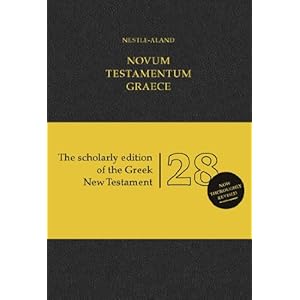
Hernandez is right, text criticism isn't what it used to be. It’s not just a new edition of the NA28 that we’re seeing, it’s a new generation of text critical tools and methods. We’re moving away from the old answers and asking all sorts of interesting questions. Returning to the manuscripts, returning to the texts as artifacts, and rethinking what variants mean for interpretation make text criticism interesting again.
When I first encountered text criticism in college it was taught as though the work was already done. Certainly there were still a few spelling differences here or there, the occasional variant to discuss, but nothing of real substance or significance. Furthermore, the concept of a stable "original" text was the attainable, almost already attained goal. Thus, text criticism was not really all that interesting, just something that had thankfully been done by someone else with the pleasant result that we had the secure text and could now do the really important work of interpreting. As R. P. C. Hanson quipped, “I look upon the text critic as I look upon the man who comes to clean drains. I should not like to do it myself, but I am very glad that someone likes to do it.”
In the last few years, however, I have noticed a substantial shift. Actually, I’m sure it goes back much further and I am just slow in recognizing it. Brushing up on recent developments in text criticism in order to teach on the subject, I was surprised to find a burgeoning sub-field of NT studies full of unanswered questions and new approaches. I assigned Robert F. Hull Jr.’s The Story of the New Testament Text to my Advanced Greek undergraduate students and they unanimously raved about it. They are fascinated by text criticism, what it means and how to actually do it. Anyone else noticing this trend?
Hernandez is right, text criticism isn't what it used to be. It’s not just a new edition of the NA28 that we’re seeing, it’s a new generation of text critical tools and methods. We’re moving away from the old answers and asking all sorts of interesting questions. Returning to the manuscripts, returning to the texts as artifacts, and rethinking what variants mean for interpretation make text criticism interesting again.