Showing posts with label #sblaar. Show all posts

Saturday, November 30, 2013

The Blow Up in Baltimore (Part 2 – The Sparks)


Having given a summary of the papers delivered during the Social Memory session in the Historical Jesus section at SBL, I know want to highlight why it was a “blow up” and offer my interpretation of the ensuing audience interaction. After a round of strong papers, each presenter was given the opportunity to respond in the same order as originally delivered.

Chris Keith primarily answered Paul Foster in his rejoinder. The reason for Keith’s response was that Foster gave what I think was an awfully uncharitable dismissal of Keith on account of a blog response to an article Foster wrote arguing that memory studies are a “dead end” for historical Jesus research (Keith’s blog post is available here). Foster made it sound as though Keith’s well-founded criticisms were childish and petty. Keith protested the fact that Foster’s article argues against memory studies as employed by Richard Bauckham, but ignore his own more nuanced approach, as well as that of Anthony Le Donne and Rafael Rodríguez. In his SBL paper Foster essentially described Keith as whining that his work was not paid sufficient attention when Keith et al did not merit attention because according to Foster, their work is not really historical Jesus research.

I thought Keith’s response was incredibly gracious, saying that while he also has qualms with Bauckham’s use of memory theory he maintains that his work is historical Jesus research. There was a palpable sense of “Oh no he didn’t” in the audience when Foster jibed Keith, but I thought Keith’s response was irenic. In general, I thought Foster failed to engage in the argument made by Keith, Le Donne and Rodríguez and Allison, among others. It seems to me that Foster wants to continue to operate historical Jesus studies by the criteria approach. It made me wonder if he has read Jesus, Criteria and the Demise ofAuthenticity. If he has, what would he say in response? Is there a review in order?

I don’t remember Crook’s response particularly well (!), but it was clear that he did not think he was correctly understood. In fact, I vividly recall one point during the Q & A, when Crook slammed his hands on the table, jumped up and exasperatedly exclaimed, “If that’s what you think I’m saying, then I’m not being heard!” In a comment he made in the previous post, it became clearer to me what he was saying. He sees the work of Keith, Le Donne and others (in Jesus, Criteria and the Demise of Authenticity) as definitive for making the Quest for the historical Jesus impossible. He believes, however, that it is still possible to study the way Jesus was remembered. He is simply convinced that there can be no confidence in memories about Jesus as more authentic/historical than others.

Crook’s argument did not convince me because it seemed that he was drawing on a different kind of research and that his epistemological assumptions were too strict to make any historical claims. I was a bit surprised to see Crook drawing primarily from an essay by Baumeister and Hastings published in 1997. Perhaps the article is seminal, but it would seem that research in collective memory has become more nuanced in the last fifteen years. Also, Crook often referred to memory studies that occur in laboratories, but it would seem that these individual studies in memory would have limited value for collective memory theory. One example that interested me was Crook’s recognition that while there are numerous stories circulating about Ned Ludd, he never existed. But, how can such a historical judgment be made? Just because false memories circulate and can be planted in individuals does not mean that we cannot come to some fairly conclusive historical judgments. Surely Crook is correct to see that memory theory ought to temper and nuance the way historical judgments are made, but does that mean they cannot be made at all?

Perhaps I’m not giving Crook his due. I wanted to ask more questions, but the audience was jumping to ask questions and I didn't get a chance. Unfortunately, some of the comments occasionally deteriorated into lengthy pontifications from the audience, but I think that speaks to how strong the reactions to the session were. I cannot emphasize enough how fantastic session this was. If you're interested in more, check out Chris Keith's reflections and the ensuing debate in the comments over at Jesus Blog.

Wednesday, November 27, 2013

The Blow up in Baltimore (Part 1 - Summary)


For me, the highlight session of this year’s SBL was in the Historical Jesus section devoted to social memory theory. While I’m not particularly interested in Historical Jesus (HJ) studies as a scholarly discipline, I am interested in social memory theory and its application to biblical studies. Also, if for no other reason than the fact that I’m a Christian I am interested in Jesus. Before offering a brief description of the four papers delivered and the ensuing discussion, I’ll first provide a little background to the debate. For those who are already somewhat familiar with the recent debate about social memory theory in HJ studies might prefer to skip the next paragraph and get right to my summaries of the papers. 

Although the relevant history goes back further, I begin with the book edited by Chris Keith and Anthony Le Donne, Jesus, Criteria and the Demise of Authenticity. In this compilation of essays released in August of 2012, Keith and Le Donne put the nail in the coffin of HJ studies based on the criteria approach, whereby scholars use a set of criteria for discerning how authentically historical a particular action or saying is. In February of 2013, Paul Foster published an article in Journal for the Study of the Historical Jesus provocatively titled: “Memory, Orality, and the Fourth Gospel: Three Dead-Ends in Historical Jesus Research”! Foster argues that “memory studies” offer no “significant advance in accessing the 'historical Jesus', as that term is usually understood.” Le Donne announced the publication of thearticle and soon after Keith offered a brief response to Foster on their co-authored Jesus Blog


The first paper, “The Past Approaching and Approaching the Past: The Contribution of Memory Studies to Historical Jesus Research” delivered by Chris Keith, was aimed at describing the value of social memory theory as a tool for HJ research. He addressed four issues to which social memory theory is relevant (1. Transmission of Oral tradition, 2. Criteria of Authenticity, 3. New Historiography and 4. Historical Reliability of the Gospel tradition). Keith showed, I think convincingly, that social memory theory requires recognizing that HJ research cannot practice business as usual because social memory theory provides a more accurate description of the way history works, but it does not do the work of the historian.


The second paper, “Memory Distortion and the Historical Jesus” read by Zeba Crook made the provocative argument that memory studies make HJ research impossible! Crook’s argument is that memory studies show us not how to refine an approach to HJ research but rather destroys any attempt to do so. Crook’s paper was punctuated by a helpful, and at times hilarious, power-point. Needless to say, Crook’s bold thesis was the most controversial prompting disagreement from just about everyone.

The third paper, “An Uneasy Concord: Memory and History in Contemporary Jesus Research,” given by Rafael Rodríguez argues that social memory theory provides a more accurate description of what the gospels actually are, and so are more suitable for doing HJ research than the previous criteria approach. The two major payoffs for HJ research are that (1) events/sayings cannot be removed from their narrative contexts in order to be evaluated for their historicity and (2) any evaluation of history must account for the production and reception of the narratives as they are. Rodríguez offered a helpful example in showing the relationship between John the Baptist and Jesus in Matthew's gospel.

The last paper, “Memory: Help or Hindrance in Historical Jesus Research?” was given by Paul Foster. His essay was by far the most narrow in focus, arguing primarily against Richard Bauckham’s use of memory theory for judging large portions of the gospel tradition as historically reliable. In general, however, Foster sees memory study practiced by Le Donne, Keith and Rodríguez as a categorical error when employed for HJ research. Foster considers memory theory a helpful way to trace the history of tradition, but not useful for making judgments about the historical Jesus.

Tuesday, November 26, 2013

SBL Purchases

Every scholar and theologian I know loves the famous Erasmus quote, "When I get a little money I buy books; and if any is left I buy food and clothes." Except Chris Keith, he loves his clothes. Is he the best dressed historical Jesus scholar?

One of the highlights of SBL is always the massive book display. Some of the prices are no better than Amazon, but there are deals to be found. Here's what I bought this year:

  A popular translation of Augy's Confessions from penguin for only $5!

An introduction to Sahadic Coptic for $18

An intriguing anthology of essays: A Companion to Second-Century Christian 'Heretics' for $20


Rafael Rodriguez's new guide for those of us perplexed by Oral Tradition and the New Testament $18


Stanley Porter's new introductory book on text criticism that goes after Ehrman, How we Got the New Testament $13

Steve Mason's Commentary on Josephus's Life $20   

Wayne Choppins' much anticipated translation of Jens Schröter's Von Jesus zum Neuen Testament, released by Baylor as From Jesus to the New Testament: Early Christian Theology and the Origin of the New Testament Canon $40

A fantastic new monograph from a younger scholar, Ryan S. Schellenberg, Rethinking Paul's Rhetorical Education: Comparative Rhetoric and 2 Corinthians 10-13 $32

The books with Bigger pictures are the ones I'm most excited to read. Be jealous.

Friday, November 23, 2012

SBL Book Purchases: Overview


I have recently become increasingly judicious in my book buying for two reasons. First, books cost money and I don’t have very much. Second, these days I spend quite a bit of time reading monographs and primary sources which are unconscionably expensive. However, I went to SBL looking for a couple of books that I either did not find or could not afford and somehow still came home with a load of books. 


Here’s what I walked away with:
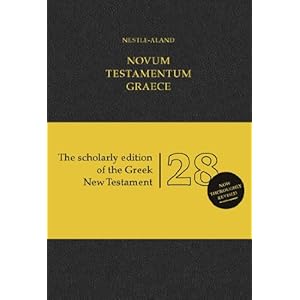
  • Nestle-AlandNovum Testamentum Graece 28thEdition - $34.00

  • R.Dean Anderson, Ancient Rhetorical Theoryand Paul (rev. edt.; Leuven: Peeters, 1998). $28.00

  • HindyNajman, Seconding Sinai: The Development ofMosaic Discourse in Second Temple Judaism (SJSJ 77; Atlanta: SBL, 2003). - $19.00

  • EmanuelTov, Scribal Practices and ApproachesReflected in the Texts Found in the Judean Desert (STDJ 54; Atlanta: SBL,2004). - $38.00

  • MatthewW. Bates, The Hermeneutics of the ApostolicProclamation: The Center of Paul’s Method of Scriptural Interpretation (Waco:Baylor University Press, 2012). $48.00

I also picked up these gems at Powell's:
  • Lucian, Selected Dialogues (trans. C. D. N. Costa)
  • Social Distinctives of the Christians in the First Century: Pivotal Essays by E. A. Judge
  • Werner Kelber's The Oral and the Written Gospel 
  • John D. Harvey's Listening to the Text: Oral Patterning in Paul's Letters
I will post reviews of some of my SBL purchases as time permits. Did you buy anything at SBL? Anything particularly exciting?

Sunday, November 18, 2012

2012 SBL / AAR in Full Swing

The largest, coolest, and best biblical/theological studies conference is currently underway in down town Chicago. My wife calls it "nerd camp," but she's not here so I stay up late reading and discussing methodology! At the moment I'm skipping a session in preparation for my own presentation in a few hours.


My initials thoughts:
  • I've already purchased far too many books.
  • The conference is ridiculously spread out. Too much walking for most folks, but strolling through Chicago has been enjoyable.
  • The city of Chicago is fantastic. Surprisingly not too cold, great city atmosphere. The only downside is that everything is ridiculously overpriced.
  • Good papers already given and lined up in the Pauline Epistles and Pauline Soteriology Sections 
In just a few hours I will be giving my first SBL presentation in the "Greek Bible Section":

S18-320
Greek Bible
11/18/2012
4:00 PM to 7:00 PM
Room: S101a - McCormick Place
Tony Michael, York University, Presiding

Mark C. Kiley, Saint John's University
Matthew: kyklos, phylakterion, kraspeda (30 min)
Edmon L. Gallagher, Heritage Christian University
The Patristic Reception of Zechariah ben Jehoiada (30 min)
Noah Hacham, Hebrew University of Jerusalem
The Concept of Exile in the Septuagint (30 min)
Tyler A Stewart, Lincoln Christian University
Lament and Victory: LXX Psalm 43.23 in Romans 8.36 (30 min)

I'll have more coherent reflections and a comprehensive list of my book purchases after my presentation is over and I'm able to simply enjoy the conference.