Showing posts with label Gospels. Show all posts

Tuesday, January 3, 2012

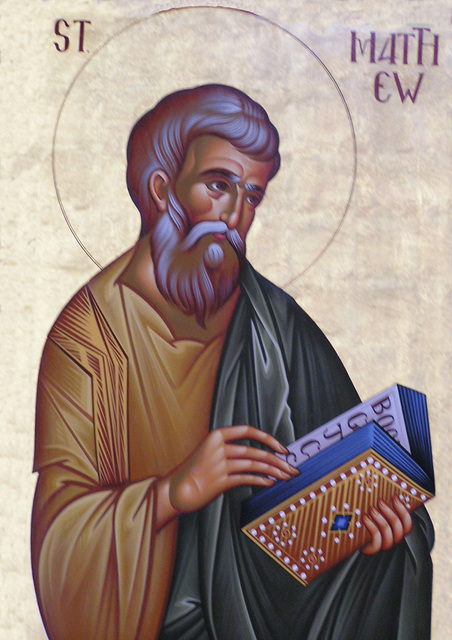
GNT2012 - Matthew 2-3


The “Magi [μάγοι]” are unique to Matthew’s gospel and fit awkwardly in the story. Nearly everything that occurs in Matthew’s infancy narrative is described as the fulfillment of prophecy (Mt 1.23; 2.6, 15, 18, 23). Even minute details, such as the escape to Egypt or settling in Nazareth, are fulfilled prophecy. Shockingly, the one exception to this fulfillment theme is the conspicuous Magi. Surely, Matthew’s creative exegesis could have made use of Isaiah 18.7, Isaiah 56.6-8, or Ps 72.10-11.  Or why not Isaiah 60.4-6, a text that mentions foreigners carrying “gold” and “frankincense” to Jerusalem in celebration of God’s glory dwelling in Israel? Yet Matthew’s Magi are not depicted as fulfilling prophecy. Matthew surely knew these texts for he cites Isa 56.7 later in his gospel (Mt 21.13). Why, then, are these significant characters uniquely not portrayed fulfilling prophecy? Perhaps Matthew intends an oblique allusion hoping his readers will make the connection? Maybe he hopes to focus his hearers’ attention on Jesus as Israel’s Messiah?

There are not many interesting textual variants in Matthew 2-3, save one. When Jesus comes out of the Jordan River, Matthew 3.17 reads, “And behold a voice from heaven saying, ‘This is my beloved son, in whom I am pleased.” Codex Bezea, a fifth century western text reads otherwise, “And behold a voice from heaven saying to him [προς αυτον], ‘You are [συ ει] my beloved son, in whom I am pleased.” The Western text turns Matthew’s public announcement into a personal message directed explicitly to Jesus. This reading is also found in synoptic parallels (Mk 1.11; Lk 3.22) which both read, “you are [σὺ εἶ] my son.” All three texts allude to the LXX Ps 2.7, an enthronement song of David that reads, “The Lord said to me, ‘You are [εἶ σύ] my son, today I have begotten you.’” This variant is possibly an attempt at harmonization with both the other gospels and Psalm 2. The allusion to Psalm 2 is also an interesting example of an instance where Matthew chose not to exploit an OT text for his fulfillment theme. It is curious to attempt to follow Matthew’s logic in applying the fulfillment theme.

Friday, January 21, 2011

Jesus in Four Hours


One of the high school students in the church where I serve goes to a public school connected with the nearby university. It's an advanced school where they call teachers "professor," the athletic programs are typically uninspiring, and students are actually expected to learn at a high capacity. So, it's something of a novelty.

A couple weeks this semester students have been given a chance to go to a variety of classes put together by other students. Sometimes the classes are taught by fellow students or by outsiders that a student knows. In this format I've been given a unique opportunity to teach about Jesus in a public high school.

I have roughly one hour for four consecutive days to teach about Jesus. If you had four hours to teach about Jesus to a group of high school students what would you teach? What questions would you want to answer?

This is what I'm thinking so far, but I'm very open to suggestions:

  1. The Gospels – what kind of literature are these books? What do they tell us about Jesus? How should we read the gospels? History? Theology?
  2. The Kingdom – Jesus' primary message was announcing the arrival of God's kingdom. Unfortunately, few people ever hear about the kingdom and what Jesus meant by it. What did Jesus mean when he announced the arrival of the kingdom of God? What did his audience think he was doing?
  3. The Cross – It is an undoubted historical fact that Jesus was crucified. Rarely, however, do we think to ask why he was put to death. I want to look at both the theology of his death articulated in the early church and the historical motives for putting Jesus to death. Why did he die?
  4. The Resurrection – Apart from the resurrection, the emergence of the early church is baffling. What did the earliest believers mean when they said Jesus was raised? How did the early Jesus followers become the church?
I'm looking for as much interaction as possible. What would you change, ignore, add? How would you teach Jesus in four hours?

Friday, December 3, 2010

Pearls before Pigs


There are some passages of scripture that I think I understand pretty well. It's not that I couldn't learn something new or discover something I didn't see before, but for the most part I think they are pretty clear. Then, there are those passages of scripture that just do not seem to make sense. The more I think about them, I realize that I don't quite understand what they mean.

I love Jesus' Sermon on the Mount (Mt 5-7). It is an amazing passage of scripture that has attracted some of the great philosophers and ethicists in history. For the most part, Jesus' teaching is quite clear. The difficult part is not interpreting his words, but actually living them out. Still, there is a passage in the Sermon on the Mount that one of my students asked me about this week that I still don't quite understand. I want to offer some reflection based on my brief study of the passage and solicit anyone to comment on what they think Jesus meant.

Matthew 7.6 is an odd verse. It appears near the end of the Sermon on the Mount and is difficult to connect to its context. Before this enigmatic verse, Jesus commands his disciples, "Do not judge, in order that you might not be judged" (7.1). He follows the command with elaboration on why disciples ought to reserve judgment (Mt 7.1-5), most chiefly because they will fall under the same judgment. After the verse, there is a teaching about prayer, which emphasizes diligent prayer and trusting God to respond (Mt 7.7-11). Crammed between a teaching about judgment on the front end and a teaching about prayer on the back end is this confusing verse, "Do not give the holy thing to dogs nor cast your pearls before pigs, lest they will trample them with their feet and turning they will tear you to pieces" (my translation).

First, it is important to clarify the logic of the passage. Jesus is giving a warning to his disciples. If you do this (give pearls the holy to dogs and cast pearls before pigs), then the dogs and pigs will trample them (i.e. the holy and pearls) and turn to devour you! Jesus is trying to prevent his disciples from engaging in this "pearl casting."

Second, there are some important cultural factors that are not immediately obvious, but important for understanding what Jesus means. For example, Jesus refers to "dogs," which to most of us are "man's best friend." But in Jesus' day, dogs were filthy and dangerous creatures (Ps 59.14-15). In the parable of the rich man and Lazarus, the poor beggar (Lazarus) has his wounds licked by dogs as a sign of his extreme poverty (Lk 16.21). Paul describes his opponents as "dogs" in the sense of "scoundrels" (Phil 3.2). Similarly, John includes "dogs" among those who are not allowed inside the New Jerusalem (Rev 22.15). For many of us, pork is an frequent part our diet. In Jewish culture, however, pigs were unclean animals (Lev 11.7-8; Deut 14.8) that became symbolic of defilement (Isa 65.4; 66.3, 17; Lk 15.15-16). In fact, when the foreign king Antiochus IV Epiphanes sought to eradicate Torah abiding Jews, he forced them to eat pork (167 BCE; 1 Macc 1.47). In brave resistance, some Jews refused to eat the pork and lost their lives to uphold the law (2 Macc 6.18-31; 7.1-42). Pigs, then, were not just unclean animals, but they were symbolic of cultural accommodation and forsaking God. Both dogs and pigs, are animals that communicate gross defilement and bad character.

What about the "holy thing" and "pearls" to which Jesus refers? "Pearl" is a rare word in the New Testament, but when it does appear it obviously refers to great wealth or value. In the pastoral letters, there is a reference to "pearls" as unbecoming of godly women who have no desire to flaunt their wealth (1 Tim 2.9). In John's apocalypse, "pearls" are a symbol of the extravagant wealth that is characteristic of "Babylon" (Rev 17.4; 18.12, 16). The same symbol of wealth is magnified in God's holy city – the New Jerusalem (Rev 21.21). Back to Matthew's gospel, Jesus tells a parable describing the kingdom of heaven of value like a pearl for which a merchant sells everything to get (Mt 13.45-46). Pearls are objects of incredible value, to which Jesus likens the kingdom of heaven. The phrase "holy thing" is usually interpreted to refer to the sacrificial offering of meat (Lev 8.31; 10.14) which was not to be thrown to dogs like the meat of a gored animal (Exod 22.31). There is no explicit identification of the "holy thing" as food. Also, one has to wonder why dogs would bite the hand that feeds them. It is a little unclear what Jesus means by "the holy thing" that should not be given to dogs, but the reference to holy food makes sense if it refers to something which ought to belong to God. The holy thing and pearl, refer to that which is of great value and belongs to God.

This passage has left many interpreters scratching their heads in confusion. In the early church, this verse was interpreted to refer to the bread and wine of the Lord's Supper, which were to be kept from non-Christians as sacred (Did. 9.5; Chrysostom, Homilies on Matthew 23). Today, many interpreters rely on the previous context about judgment (Mt 7.1-5), and suggest that Jesus is encouraging his disciples to be discerning about with whom they share the gospel. The difficulty, here, however is that Jesus is not discerning. Instead, he openly announces the kingdom, gets himself killed for doing so and calls his followers to do the same! It just does not make sense to read this way, but for lack of a satisfying alternative few other interpretations have been suggested.

So what did I tell the student that asked me about this passage? I think Jesus is telling us to beware of placing our trust in dogs and pigs. I heard this interpretation in a journal article on the structure of the Sermon on the Mount by Glen Stassen. In the article, Stassen argues that this odd verse cannot mean "be judicious in who you tell the gospel," and observes that in the context of the following verses about prayer (Mt 7.7-11), Jesus emphasizes trusting God to provide for your needs. Stassen argues, and in my opinion this is the most compelling interpretation, that Jesus is warning his followers not to put their loyalty (i.e. that which is holy and of greatest value) in dogs and pigs – scoundrels and idolatrous men. In the context of the first century, pigs were particularly associated with the Roman Empire, and it would be easy for Jesus' listeners to understand this as a veiled reference to an oppressive ruler. It seems to me, via Glen Stassen, that Jesus is warning his disciples against putting their trust in a political system to provide. God alone deserves that trust and allegiance. Stassen's suggestion is the best I've heard.

Any other suggestions? Am I missing something significant? What do you think Jesus meant?