Showing posts with label Theodicy. Show all posts

Monday, May 20, 2013

What makes God good in a world of tornadoes?

This morning I read an old book by a theologian who has been dead for thousands of years and titled the post "What makes God good?" The post describes how ancient Christians thought long and hard about how to affirm God's goodness in a world where suffering is real and terrible. It also highlights the danger of ill-formed answers to difficult questions. I ended the post with the question that originally caught my attention while reading the ancient theologian's words, "What makes God good?"

Roughly four hours after I published the post I was alerted to the massive Tornado that ravaged Moore, Oklahoma this afternoon, killing 51 people and injuring at least an additional 120.  CNN is reporting that 20 or more of those killed were children. The Tornado comes just shy of the two year anniversary of the May 22, 2011 Joplin Tornado. The horrific effects of which I witnessed firsthand. These natural disasters are keen reminders that asking the question, "What makes God good?" is much more than an academic exercise. When tornadoes churn death, tragedies kill, and diseases devastate, theological arguments often sound petty, detached, and even blasphemous. The words of a brilliant, long-dead theologian seem like hair-splitting minutia, lifeless and empty.

A boy rescued from beneath at collapsed wall
at the elementary school in Moore, OK where
the EF4 tornado hit 5/20/2013
(AP Photo by Sue Ogrocki)
Found here.
A wise and honest friend commented on a link to my earlier post:
"I think that when sweet children get killed by violent storms people are looking for answers and not questions."
I once drove to the door of parents morning the inexplicable death of their child. I hoped and prayed every second of that drive that God would give me answers for them. When the door swung open we embraced and prayed together. I had no answers to why their daughter was dead. I had no logical explanation that would make the pain go away. I still don't. 

But the Christian God is not aloof from our suffering. He is not distant or ignorant or uncaring. I do not believe that God orchestrates all suffering to teach us a lesson or to work a mysterious plan that cannot be understood by the human mind. I think, rather, that God is just as appalled by evil as anyone. In fact, I think he's more appalled by it, he's righteously appalled. He hates it with a perfect hatred. He hates sin and death so much that he has gone to great lengths to rescue the world from it. This is the Christian answer to the problem of evil-- the cross and resurrection. Christians believe that the world is not as it should be and at the same time we believe that God has decisively acted to rescue us from the evil of the world. Now he has called and commissioned us to participate in his new creation. In this new creation the old order of things has passed away, and God wipes every tear from our eyes, and there is no more death, or mourning, or crying, or pain.

We believe that one day our perishable bodies will be raised and clothed in immortality and we will shout:
Death is swallowed up in victory! Where, O Death, is your victory? Where o death is your sting? (1 Cor 15:54-55)
On days like today we feel the sting of death. But we trust that God will condemn sin, suffering, and death, fully and finally at the resurrection.

So what do we do until then? 

We do the work of people who believe that God created the whole world and is at work redeeming it through his church. We pray, we serve, we rebuild, we wait for resurrection with a joyful resilience because we have caught a glimpse of how the story ends. 


Teacher embraces a child at an elementary
hit by the Tornado on 5/20/2013.
(AP photo by Paul Hellstern)
Found here.

After a lengthy description of resurrection hope, St. Paul encourages:
Be steadfast, immovable, always overflowing in the work of the Lord knowing that your labor in the Lord is not in vain (1 Cor 15:48).

What makes God good?

Whether someone believes in a creator, as Christians do, or he is an atheist, evil is a glaring philosophical problem. It confronts the believer with doubts about the goodness of a god who could make a world filled with starving children. Likewise, suffering confronts the atheist with questions about how to define “evil” and how to confront it.

The earliest Christians were not oblivious to the problem of affirming the goodness of a creator and the constant reality of suffering and evil. They wrestled with the difficulty and purposed a number of responses. 
One response, proposed most famously by Marcion, argued that the god who created the world was to blame for evil but the heavenly father of Jesus released believers from captivity to the trappings of material things turning them instead to the spiritual. This proposal, if I can oversimplify, says, “There is a god responsible for creating evil, he’s the god of the Jews found in the Jewish Scriptures. But that’s not the god we worship in Jesus. In fact, Jesus came to set us free from captivity to that evil god and to worship his loving, kind heavenly father.” 

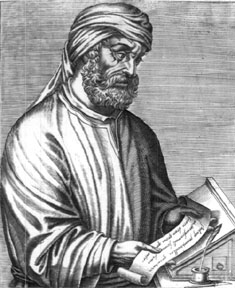
Tertullian, the father of Latin theology pictured above, argued that in his attempt to find a good, kind, loving god, Marcion invented a god that is really no good at all. In his response, Tertullian created a rubric for measuring the goodness of a god (Against Marcion 1.22–25). According to Tertullian, a good god must be eternal, rational, and perfect. Each attribute is aimed as an attack on Marcion’s theology.

Marcion’s solution to the problem of evil was to blame it on the creator thus absolving the heavenly father. But, Tertullian argued that a truly good god could not just arrive on the cosmic scene after creation. From a good God “we shall expect goodness to be perennial and ever-flowing, [. . .] being stored up in readiness with the treasuries of his natural attribute” (Against Marcion 1.22). If a god is truly good, then that goodness has to be on display from the very beginning of time. Otherwise he is only good on a whim, and that’s not really good. If Marcion's god is good, then, where was he when the evil creator did his creative work? Why didn’t he stop it? Why did he wait so long to provide a solution? For a god to be truly good, he has to be eternal.

Marcion’s redeemer releases humans from fleshy living in order to become truly spiritual and non-physical. This kind of salvation is inadequate, according to Tertullian because such a god fails to rescue humanity and settles for an escape from their created existence. Tertullian mocks:
“I should reckon no man more presumptuous than the one who in one God’s water is baptized for another god, who towards one God’s sky spreads out his hands to a different god, bows down upon one God’s soil to a god whose soil it is not, over one God’s bread give celebrates thanksgiving to another.” (Against Marcion, 1.23)
His point is that Marcion’s god is irrational because he fails to redeem humanity and instead offers an escape from the creator god. Such a salvation does not make sense. For Tertullian, a good god must be rational.

Lastly, a good god must be perfect. Similar to the previous critique, Tertullian is referring to a perfect salvation. A salvation of the soul is imperfect, because humans are not just souls. We have bodies, flesh and blood, and so for us to be rescued our bodies must also be saved by a good god. A god that can only save part of us is not a perfect and thus not a good god.

What do you think it means for a god to be “good”? 
This is a crucial question for thinking through the problem of evil. If a “good” god acts like us, is he really good? Or is he just what we want?