Showing posts with label Theology. Show all posts

Monday, May 20, 2013

What makes God good?

Whether someone believes in a creator, as Christians do, or he is an atheist, evil is a glaring philosophical problem. It confronts the believer with doubts about the goodness of a god who could make a world filled with starving children. Likewise, suffering confronts the atheist with questions about how to define “evil” and how to confront it.

The earliest Christians were not oblivious to the problem of affirming the goodness of a creator and the constant reality of suffering and evil. They wrestled with the difficulty and purposed a number of responses. 
One response, proposed most famously by Marcion, argued that the god who created the world was to blame for evil but the heavenly father of Jesus released believers from captivity to the trappings of material things turning them instead to the spiritual. This proposal, if I can oversimplify, says, “There is a god responsible for creating evil, he’s the god of the Jews found in the Jewish Scriptures. But that’s not the god we worship in Jesus. In fact, Jesus came to set us free from captivity to that evil god and to worship his loving, kind heavenly father.” 

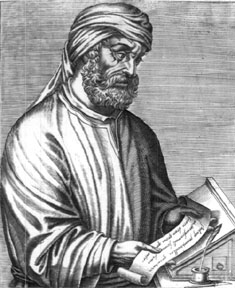
Tertullian, the father of Latin theology pictured above, argued that in his attempt to find a good, kind, loving god, Marcion invented a god that is really no good at all. In his response, Tertullian created a rubric for measuring the goodness of a god (Against Marcion 1.22–25). According to Tertullian, a good god must be eternal, rational, and perfect. Each attribute is aimed as an attack on Marcion’s theology.

Marcion’s solution to the problem of evil was to blame it on the creator thus absolving the heavenly father. But, Tertullian argued that a truly good god could not just arrive on the cosmic scene after creation. From a good God “we shall expect goodness to be perennial and ever-flowing, [. . .] being stored up in readiness with the treasuries of his natural attribute” (Against Marcion 1.22). If a god is truly good, then that goodness has to be on display from the very beginning of time. Otherwise he is only good on a whim, and that’s not really good. If Marcion's god is good, then, where was he when the evil creator did his creative work? Why didn’t he stop it? Why did he wait so long to provide a solution? For a god to be truly good, he has to be eternal.

Marcion’s redeemer releases humans from fleshy living in order to become truly spiritual and non-physical. This kind of salvation is inadequate, according to Tertullian because such a god fails to rescue humanity and settles for an escape from their created existence. Tertullian mocks:
“I should reckon no man more presumptuous than the one who in one God’s water is baptized for another god, who towards one God’s sky spreads out his hands to a different god, bows down upon one God’s soil to a god whose soil it is not, over one God’s bread give celebrates thanksgiving to another.” (Against Marcion, 1.23)
His point is that Marcion’s god is irrational because he fails to redeem humanity and instead offers an escape from the creator god. Such a salvation does not make sense. For Tertullian, a good god must be rational.

Lastly, a good god must be perfect. Similar to the previous critique, Tertullian is referring to a perfect salvation. A salvation of the soul is imperfect, because humans are not just souls. We have bodies, flesh and blood, and so for us to be rescued our bodies must also be saved by a good god. A god that can only save part of us is not a perfect and thus not a good god.

What do you think it means for a god to be “good”? 
This is a crucial question for thinking through the problem of evil. If a “good” god acts like us, is he really good? Or is he just what we want?

Wednesday, November 21, 2012

Dogmatics Deal

Karl Barth's massive (14 volumes) English translation of Church Dogmatics is on sale for $89.99 at Christianbook.com. This is the best price I've ever seen.

Here are some good reasons you should read Barth.


If nothing else, this will make your bookshelf look impressive.

tolle lege.

Tuesday, October 9, 2012

Why Historical Jesus Studies Are Useful for the Church


In the recently published volume Jesus, Criteria, and the Demise of Authenticity, Scot McKnight writes a chapter arguing that historical Jesus (HJ) studies are useless for the church. I gave a lengthy review of his argument here. I find McKnight’s argument problematic for at least four reasons.

First, McKnight’s argument that HJ studies are useless for the Church largely ignores the central focus of the book, the misuse/problematic nature of the criteria of authenticity. He only mentions the criteria approach in his second point and then argues that a memory approach is not without its problems in failing to produce a “genuine” Jesus. The focus of the book is how to do better HJ work by moving past the “criteria approach,” which failed to yield what it promised. Ignoring the project of the book is, in my opinion, tantamount to arguing that history does not matter. In the end, all believers have is the “Church’s Jesus.” This seems to me a failure to “take the incarnation seriously” as Dagmar Winter put it in her presentation at the conference.

Second, McKnight is emphatic that the Church’s Jesus is the only valid Jesus for believers. My problem here is that the Church does not have one Jesus. In the canonical gospels alone there are four Jesuses. The preface of Luke’s gospel might well indicate that he found the other reconstructions less than satisfactory and sought to produce a better, more “accurate [κριβς]” reconstruction (Lk 1.1-4). Even if Luke is not implicitly critiquing the other gospels he is at least suggesting that more than one is necessary (cf. Jn 20.30-31). The canonical gospels present us with four Jesuses and we have the Jesuses of the apocryphal gospels indicating that some strands of early Christianity saw value in adding to the existing reconstructions. Therefore, the argument that the Church has one Jesus is simply not true. The church has always had many reconstructions of Jesus.

Third, McKnight appeals to “the Creeds” to argue for the singular “Church’s Jesus,” but I wonder which Creeds and whose church? The Jesus of the Episcopalian Church is radically different from the Evangelical Jesus. The Jesus of Roman Catholicism is different from the Eastern Orthodox Jesus. Taking this point even further, the Jesus of my church is different than the Jesus of McKnight’s for the simple reason that we hear different sermons, practice different liturgies, confess (or don’t confess) different creeds. There is no question that there are various Jesuses and that each church is involved in the “meaning making” of its Jesus. The question is whether or not good historiography can help churches have a more historically accurate Jesus, a Jesus not determined by cultural convention or local preference. I am of the opinion that it can, even that it must.

Fourth, McKnight’s lamentation of the fact that portraits of Jesus shift in each generation is not, in my opinion, a bad thing. History and theology must be culturally relevant; otherwise they are simply chasing the wind. Thus, it’s not a surprise that portraits of Jesus change in different cultures. I contend that using good historical methods can help believers see outside of their culture and get a more accurate picture of Jesus. That historical Jesus reconstructions change is a neutral fact, neither positive nor negative. The question, again, is whether or not historical methods can help provide a more accurate Jesus for churches. I believe they can.

I think McKnight’s argument for the “Church’s Jesus” results in a static figure, a theological statement more than a historical person. [McKnight's own work shows that he is very interested in history, in seeking the historical person, and thus seems to me to refute in practice what he articulates in theory.] The Jesus seen in the four gospels, the apocryphal gospels, the creeds, sermons, liturgies, and the history of Christianity remind us that the Church is always re-interpreting the narratives, constructing new narratives, asking new questions and developing new methods of historical investigation. Among other things, historical method can help prevent the Church from making the historical person of Jesus in our theological image. [McKnight, himself works to keep the Church from making Jesus in its theological image through his historical studies.] As Jens Schröter reminds us in his fine essay, historical sources have a certain “veto power” to prevent us from reconstructing narratives out of thin air (64, citing Reinhart Koselleck). The HJ “enterprise,” as discussed throughout Jesus, Criteria, and the Demise of Authenticity helps the Church by creating more disciplined critical reconstructions, by keeping theology from riding rough-shod over history and thus over Jesus, the historical person.

Please note additions placed in [brackets] in response to Scot McKnight's comments on this critique. 

Monday, October 8, 2012

Why the Historical Jesus is of No Use for the Church


The only contributor to Chris Keith and Anthony Le Donne’s Jesus, Criteria, and the Demise of Authenticity who did not attend the conference last weekend was Scot McKnight. I have never personally met McKnight and would have liked to do so. He seems an affable person and a good scholar. You can find him on the web at his blog Jesus Creed.

Having heard each contributor give a presentation of parts of his or her chapter at the conference, upon returning home I immediately read McKnight’s essay. He provocatively titled his contribution, “Why the Authentic Jesus is of No Use for the Church,” but I went ahead and crossed out “Authentic” and wrote “Historical” instead, because I think that is what he means. This is a two part post. Part one consists of a description of McKnight’s argument. Part two is my critique.

McKnight begins by asserting that all historical Jesus work is theological and that historical reconstructions provide each historical Jesus scholar with the Jesus he or she “believe[s] in” (174). Additionally, he argues that historical methods are useful and able to yield “a ‘historical’ Jesus or a historian’s Jesus or a Jesus as he can be reconstructed through historical methods” (174). He argues that historical Jesus research is fundamentally reconstructing Jesus which produces “a theological Jesus for that scholar and those who agree with him or her” (175, emphasis original).

Since the task is reconstruction, McKnight asserts, “The historical Jesus enterprise is designed to take apart the Church’s Jesus [. . .] and the Gospels in order to find what is historical [i.e. what really happened] and then to construct an image of Jesus on the basis of what survives the test” (175). Such work reconstructs and thus deconstructs the portraits of Jesus in the canonical Gospels. As a result, McKnight contends that “historical Jesus proposals are of no use to the Church—at all” (175, repeated throughout the essay 176, 178, 179, 180, 182, 184). To be clear, McKnight does not think historical reconstruction is “wrong or impossible, but that it does not help the church” (178).

Why exactly does McKnight think historical Jesus studies “useless” for the church? Succinctly,
When the Jesus we have (re)constructed is no longer orthodox or the Jesus of the canonical Gospels or the Jesus of the regula fidei, the Jesus we have is no longer the Jesus of the church, and a Jesus who is not of the church is not a Christian Jesus. That Jesus was virginally conceived as a result of an act of God, lived as a Galilean Jew, preached the kingdom and did miracles and all that, died and was buried and was raised from the dead by God, and was exalted to the right hand of God, and will come again. And these acts are saving and forgiving and justifying and reconciling in such a way that those who participate in that Jesus are granted eternal life. That Jesus is the Second Person of the Trinity. He is divine and he is human, fully God and fully man. (176)
McKnight goes on to make four specific contentions about why he thinks historical Jesus research is useless for the Church.

First, he argues that reconstructions remake the meaning of Jesus but the meaning of Jesus has already “been made by the Gospels and the creeds” (176). For McKnight, the narratives of the canonical Gospels and the interpretations of the Creeds produce the Church’s Jesus, a Jesus that cannot be deconstructed and still serve the Church.

Second, McKnight argues that “the criteria will not permit us to get back to a Jesus that is intellectually compelling to more than a gaggle of like-minded scholars” (180). Oddly, he switches to the book project with the word “criteria,” but up until this point he has simply referred to historical reconstruction. His point here is simply to observe that despite the painstaking efforts of brilliant scholars, “the criteriological approach to Jesus is facing now a crisis in confidence” (182). This makes me wonder if McKnight would see value in historical Jesus studies for the church if scholars agreed on a particular historical Jesus.

Third, McKnight thinks that historical Jesus studies are useless for the church because, “memory studies dampen enthusiasm for the kind of confidence needed to construct a genuine historical Jesus” (182). McKnight references Dunn’s argument that all we have is the “remembered” Jesus (Jesus Remembered). It is unclear to me what McKnight means by “genuine” but it appears that he is critiquing memory studies for failing to give us criteria-like-assurance of firm results, providing “genuine” sayings, deeds, etc. The central point of the book as a whole is that the criteria approach does not give us assured results.

Fourth, “the historical Jesus enterprise is of no use to the church because [. . .] historical Jesus studies shift and change from generation to generation, and that means the Jesus offered changes, and that means the church [. . .] would be asked to re-do its Christology every generation” (184). He rhetorically asks whose Jesus would be followed and who will make that decision.

McKnight, then, sees no value for the church in historical Jesus studies. What do you think? 

I'll post my critique tomorrow.

Saturday, September 10, 2011

The Cross and 9/11

One of my favorite preachers, Methodist Bishop Will Willimon offers sobering reflection on his reaction to the terrorist attacks of September 11, 2001:
On 9/11 I thought, For the most powerful, militarized nation in the world also to think of itself as an innocent victim is deadly. It was a rare prophetic moment for me, considering Presidents Bush and Obama have spent billions asking the military to rectify the crime of a small band of lawless individuals, destroying a couple of nations who had little to do with it, in the costliest, longest series of wars in the history of the United States. 
The silence of most Christians and the giddy enthusiasm of a few, as well as the ubiquity of flags and patriotic extravaganzas in allegedly evangelical churches, says to me that American Christians may look back upon our response to 9/11 as our greatest Christological defeat. It was shattering to admit that we had lost the theological means to distinguish between the United States and the kingdom of God. The criminals who perpetrated 9/11 and the flag-waving boosters of our almost exclusively martial response were of one mind: that the nonviolent way of Jesus is stupid. All of us preachers share the shame; when our people felt very vulnerable, they reached for the flag, not the Cross. 
September 11 has changed me. I'm going to preach as never before about Christ crucified as the answer to the question of what's wrong with the world. I have also resolved to relentlessly reiterate from the pulpit that the worst day in history was not a Tuesday in New York, but a Friday in Jerusalem when a consortium of clergy and politicians colluded to run the world on our own terms by crucifying God's own Son. (From Christianity Today via Scot McKnight)
My hope is that tomorrow preachers will follow Paul's example,
And when I came to you brothers, I did not come with rhetorical flair or wisdom while proclaiming the mystery of God. For I determined to know nothing among you except Jesus Christ, the crucified one. I came in weakness, fear and excessive trembling. My speech and my message were not persuasive wise words, but a demonstration of the Spirit and power, so that your faith might not be in wisdom of men but in the power of God.  
Though we do speak wisdom among the mature. It's not a wisdom of this age nor of the rulers of this age (those being brought to nothing). No, we speak the wisdom of God shrouded in mystery, which God predestined before the ages for our glory. It is the wisdom that none of the rulers of this age knew. For if they had known, they would not have crucified the Lord of glory (1 Corinthians 2.1-8 my translation) 
Whatever your political leanings or national affiliation, please remember that tomorrow is about the Crucified King. Any message that tells a story of revenge or justifies killing people in the name of "justice" is just perpetuating the same wisdom of this age. That's not the wisdom of God. The wisdom of God is a Crucified King. 

Friday, May 20, 2011

Why the rapture won’t happen . . . EVER!

Yesterday afternoon a frantic member of the church called looking to speak to one of the two preaching ministers on staff. Unfortunately, both of them happened to be out of the office at that particular moment. Frustrated the man asked, “Is Saturday the end of the world?” He was, of course, referring to the nonsense espoused by familyradio.com. Their website claims that the Bible guarantees May 21, 2011 as “Judgment Day.”

Flustered by the question, our sweet little administrative assistant simply said, “Only God knows.” That was the end of the conversation. I only wish that was the end of the rapture craziness.

A quick glance through history shows that many well-intentioned but grossly uninformed Christians have made erroneous predictions about when the end of the world would come. As early as 172 CE a movement of Christians began claiming that they would be the last generation. One of their prophetesses declared, “After me there will no longer be a prophet, but the end” (Epiph. Haer. 48.2.4). At the dawn of the reformation, one of Martin Luther’s students, Thomas Müntzer (ca. 1488‒1525) became fascinated with end-times speculation. Müntzer believed that God promised a victory for the peasants against their feudal lords and that Müntzer, leading the charge, would catch the enemy’s cannonballs in his coat sleeves. When a rainbow appeared, he declared it was a confirmation that God would give the peasants victory. The revolt was crushed with devastating force shortly thereafter. More recently, Hal Lindsay in his wildly popular theological train-wreck, The Late Great Planet Earth declared in no uncertain terms, that the “rapture” would occur in 1988. These are just a few of the many examples cited by Richard Kyle in his helpful little book, The Last Days are Here Again: A History of the End Times. All of this speculation in spite of the fact that Jesus said, “no one knows, not even the angels of heaven, nor the Son, but only the father” when the day of judgment will come (Mt 24.36).

So, clearly history teaches us that predicting the last day of the world is stupid, but what about scripture? The claim of familyradio.com is that the Bible is the sole source of their prediction. Apparently they missed the thing that Jesus said about no one knowing? Regardless, it is worth pointing out that the key "rapture passages" teach the exact opposite of what rapture theorist claim. Not only is it not found in scripture, it is bad theology and it contradicts what Jesus does say about final judgment.

Let’s be clear. I am not saying there is no final judgment. I am saying there is NO RAPTURE. The word “rapture” appears nowhere in the Bible. So, we have to look at the definition of the rapture, by those who believe it, and look at scripture to see if the two align.

Rapture advocates define the rapture as,
His appearance in the clouds will be veiled to the human eye and NO ONE WILL SEE HIM. He will slip in, slip out; move in to get His jewels and slip out as under the cover of night.[1]

The word ‘rapture’ means to snatch away or take away. [. . .] Someday, [. . .] Jesus Christ is coming to take away all those who believe in Him. He is coming to meet all true believers in the air.[2]

The rapture is the secret coming of Christ to take his faithful church out of the world initiating the 7 year tribulation before the millennial kingdom. This idea is built on bad readings of scripture. There are two main passages cited to support the idea of a rapture. The first passage cited to support the rapture theory is Matthew 24.36-41. It is worth quoting the passage in full,
36 “No one knows about that day or hour, not even the angels in heaven, nor the Son, but only the Father. 37 As it was in the days of Noah, so it will be at the coming of the Son of Man. 38 For in the days before the flood, people were eating and drinking, marrying and giving in marriage, up to the day Noah entered the ark; 39 and they knew nothing about what would happen until the flood came and took them all away. That is how it will be at the coming of the Son of Man. 40 Two men will be in the field; one will be taken and the other left. 41 Two women will be grinding with a hand mill; one will be taken and the other left.”

Rapture advocates suggest that the passage clearly refers to a rapture. Here you have the righteous being taken away unexpectedly. Unfortunately, the interpretation does not fit the passage. If you read the text closely, the righteous are not the ones taken, but rather it is those who did not expect the flood that will be “taken away” (Mt 24.39). Reading the text slowly it is obvious. So, at the coming of the son of man, the evil ones will be the ones will be “taken away” in judgment leaving the righteous. The logic of the passage is the exact opposite of a rapture of the righteous.

The second key passage is from Paul’s first letter to the Thessalonians (1 Thess 4.13-18). Again, the entirety of the passage requires quotation,
13 Brothers, we do not want you to be ignorant about those who fall asleep, or to grieve like the rest of men, who have no hope. 14 We believe that Jesus died and rose again and so we believe that God will bring with Jesus those who have fallen asleep in him. 15 According to the Lord’s own word, we tell you that we who are still alive, who are left till the coming [παρουσία] of the Lord, will certainly not precede those who have fallen asleep. 16 For the Lord himself will come down from heaven, with a loud command, with the voice of the archangel and with the trumpet call of God, and the dead in Christ will rise first. 17 After that, we who are still alive and are left will be caught up together with them in the clouds to meet [ἀπάντησιν] the Lord in the air. And so we will be with the Lord forever. 18 Therefore encourage each other with these words.
This is the most important rapture passage. Based on a superficial reading, rapture advocates suggest that here Paul is outlining how believers will be raptured at the second coming of Jesus.  This reading is problematic for a number of reasons. First, in a practical vein, what comfort would it be to the grieving Thessalonians that God would rapture some future generation of believers but let the Thessalonians go on suffering? Second, and more importantly, the language of the passage clearly indicates that Paul is not describing believers leaving earth forever, but rather meeting their king as he comes to reign on earth. The word for “meet” refers to a  meeting with someone for the purpose of bringing them back from where you originally came. The word occurs only two other times in the NT, both times indicate a meeting with the intent to return to the point of original (Acts 28.11-16; Mt 25.6). Similarly, the Jewish historian Josephus (Jewish Wars 7.100‒102) describes the scene of a conquering general marching into a city and "meeting" at his "coming,"

(100) But when the people of Antioch were informed that Titus was approaching, they were so glad at it, that they could not keep within their walls, but hasted away to give him the meeting; (101) nay, they proceeded as far as thirty furlongs, and more, with that intention. These were not the men only, but a multitude of women also with their children did the same; (102) and when they saw him coming up to them, they stood on both sides of the way, and stretched out their right hands, saluting him, and making all sorts of acclamations to him, and turned back together with him.

Josephus describes precisely the spectacle that Paul is using as a metaphor to describe the return of Jesus. This same idea is implied with the word “Coming” [παρουσία] which literally means “presence” (Cf. 2 Cor 7.6; Phil 1:26). In the ancient world there was a common spectacle whereby citizens would leave their city to meet a visiting dignitary or newly appointed king. Then, these citizens would accompany their ruler back to the city and celebrate. Paul is drawing on this imagery to encourage suffering believers of their coming vindication as they will rise to meet Jesus and celebrate his eternal reign on earth.

The will not be a rapture. Not today, not tomorrow not ever.


[1] Oral Roberts, How to be Personally Prepared for the Second Coming of Christ (Tulsa, OK: Oral Roberts Evangelistic Association, 1967) pg 34.
[2] Hal Lindsay with C.C. Carlson, The Late Great Planet Earth (New York: Bantam books, 1970) pg 126.

Thursday, May 19, 2011

Why the "New Atheists" are Irrelevant

Reading N. T. Wright’s recent response to the overwhelming inadequacy of Stephen Hawking’s atheist dribble reminded me of a fantastic book that I didn’t review here, Atheist Delusions: The Christian Revolution and its Fashionable Enemies.

Atheist Delusions: The Christian Revolution and Its Fashionable EnemiesLet me first say that David Bentley Hart is, in my opinion, the crème de la crème of contemporary theologians. Even if you want to dismiss Christianity, he’s the guy you have to deal with if you want to do so genuinely. You’ll need a dictionary close by to even work your way through his more “popular-level” work, but it’s worth it. He is an orthodox theologian who writes with lively density and intellectual force.

Hart is more than willing to lampoon intellectually vacuous atheism, which rests on “oceans of historical ignorance, made turbulent by the storms of strident self-righteousness . . . as contemptible as any other form of dreary fundamentalism” (3). Consider his estimate of Dawkins (3),
Richard Dawkins, the zoologist and tireless tractarian, who-despite his embarrassing incapacity for philosophical reasoning-never fails to entrance his eager readers with his rhetorical recklessness.
But, he’s also more than willing to admit that, “there are many forms of atheism that I find far more admirable than many forms of Christianity or of religion in general” (4). Hart’s goal is to force people to reckon with real Christianity historically.

The book that ensues is a rigorously historical account of the growth and expansion of the early church. Along the way he shows what the gospel has done. “A world from which the gospel had been banished would surely be one in which millions more of our fellows would go unfed, unnursed, unsheltered, and uneducated” (15). This is not a romantic claim, but a historical fact. He also attempts to show that many contemporary accounts of Christianity as nonsense are based on “extraordinarily bad arguments” because they are “driven by the precritical and irrational impulses of the purest kind of fideism” (19-20). See what I mean about a dictionary.

Ultimately, he wants to undermine the modern myth of freedom and progress as a farce. The story – “The story the modern world tells of itself now is the story of how we Westerners finally learned to be free, for the first time ever; and so it is also necessarily a story about the bondage from which we have escaped” (25). This story, he says, is grossly inaccurate. Many of the best ideals of modern culture are in fact taken from a Christian worldview without any thought as to how those ideals might be rooted in a coherent belief system. He suggests that the modern myth inevitably results in nihilism.

If you want to understand why serious Christian thinkers don’t take Dawkins and his ilk seriously read this book. If you want to understand the ethics of Christianity in a historical perspective read this book. If you want to read really good writing, read this book. Have I given you enough reasons yet? 

Thursday, June 17, 2010

Life as Theology

It is difficult for me to describe the impact Stanley Hauerwas' work has had on my life. The book he co-authored with William Willimon, Resident Aliens is one of the most personally influential books I have ever read. I first stumbled across the book for an Acts term-paper during my first semester of Bible College. I was so engrossed I could not put it down. While I think the theology articulated in that book is quite relevant to how Acts ought to shape Christian lives today, it is not the best resource for an exegetical term paper. I ended up devouring the book in a day or two rather than working on my paper. In the end, the term paper was in quite bad, but the book has had a lasting impact.

It was not until reading Hauerwas' latest book, Hannah's Child: A Theologian's Memoir, that I was reminded how important my friends' reactions to Resident Aliens were for me. After my initial reading I wasn't quite sure what to do with the book. I knew I loved it, but I had no idea what to do with it. I had not yet made the friendships necessary to have the capacity for Resident Aliens. I wondered how seriously I should or even could take this odd little book. I can liken my reaction to Hauerwas' initial response to reading The Politics of Jesus, "He wrote clearly and powerfully. I was overwhelmed. I also assumed that he had to be wrong [. . .] pacifism had to be a mistake" (116). It wasn't until I began to learn from the force of nature that is Thom Stark that I had the capacity to take Resident Aliens and Stanley Hauerwas seriously. Thom and I have our differences but he was profoundly influential in making me come to terms with the implications of a cross shaped gospel. He is also a dear friend. He taught me that it did not matter if I liked the idea of pacifism, which I did not, what mattered was whether or not I would follow a crucified Messiah and be honest with the gospel that claimed my life.

Of course, Thom Stark is not solely to blame for my pacifism. A lot of it had to do with reading the book of Revelation, John Howard Yoder and spending time with friends who really thought God mattered. So it's also the fault of scripture, witness and community. Soon I was convinced that following Jesus meant forsaking violence. It was because of friends like Thom and others that I could read Hauerwas. I was delighted to discover that his memoir is, in many ways, "a testimony to friends" (286). It was true for Hauerwas and has been true for me, "I cannot separate what I think from who I know. People make all the difference" (196).

Hannah's Child is a fascinating and exciting book. I had trouble putting it down to "work." I loved hearing the stories of how Hauerwas met and was challenged by some of the greatest theological and philosophical minds of the 21st century. It was also an intensely personal reflection on his failed marriage and his role as a father. I have long thought that a person's theology cannot be separated from their life, something I no doubt read in Hauerwas and learned from Michael DeFazio. In Hannah's Child Hauerwas offers his life as the embodiment of his theology. It is, in my mind, one of his most important books. If nothing else, you will be challenged to take God seriously by someone who doesn't have time for hypocrisy. Rather than offer any critique, which I don't really know how to do with this book, I will share Hauerwas' words that I found insightful:

On the insufficiency of faith as intellectual assent:

"The grammar of 'belief' invites a far too rationalistic account of what it means to be a Christian. 'Belief' implies propositions about which you get to make up your mind before you know the work they are meant to do." (x)
"I m not interested in what I believe. I am not even sure what I believe. I am much more interested in what the church believes." (254)
"I hold no conviction more determinatively than the belief that prayer names how God becomes present to us and how we can participate in that presence by praying for others." (281)
On learning

"I slowly learned by his [John Score's] example that to be a Christian meant that you should never protect yourself from the truth." (11)
"I think reading Nietzsche had convinced me that how Christians lived surely must be crucial for understanding how, if at all, what Christians say they believe might be considered true." (51)
On living out of control:

"Learning to live out of control, learning to live without trying to force contingency into conformity because of our desperate need for security, I take to be a resource for discovering alternatives that would otherwise not be present." (137)
"What so often makes us liars is not what we do, but the justifications we offer for what we do. Our justifications become the way we try to defeat the contingencies of our lives by telling ourselves consoling stories that suggest we have done as well as possible." (159)
I find it only appropriate to conclude this little reflection with a testimony to the friends who have made my life possible. Thanks to the friends and mentors who always remind me that God matters. Michael, Dan, Jay, Lane, Jordan, Josh, Thom, Shane and Sarah, the Dougs, the Marks, Jason, Kyle, Dr. Lowery and of course Margo, you have taught me and continue to teach me what it means when I say "God."