The gospel is not primarily an intrapsychic phenomenon that limits itself to the conversion of individual souls climbing out of a lost world into the safety of the church, like drowning people climb aboard a safe vessel. Rather the gospel proclaims the new state of affairs that God has initiated in Christ, one that concerns the nations and the creation. (8)
Monday, December 19, 2011
Beker on Paul's Theology
Thursday, July 8, 2010
Campbell’s Quest
The Quest for Paul's Gospel was released in 2005 and is a compilation of various essays; some previously published elsewhere, and brought together into one volume. Campbell's work is lucid, persuasive and (he hopes) paradigm shifting. Campbell begins Quest with a lament for the general lack of clarity regarding Paul's theology as a whole. So his book "is essentially a sketch of what we might dub the 'grand strategic' level in the debate concerning Paul's theology, a level that in my view has been missing from much current scholarly discussion" (1). The general failure of the SBL seminar on Pauline Theology during the 1980s and 90s, to come up with "more decisive conclusions [. . .] or even with the correct methods and/or questions for identifying those," Campbell thinks is indicative of the disarray of the grand strategy. Campbell admits that a lot of work, even good work, is being done on Paul's letters, but this work is glaringly "unsure of its overall objectives and thus of its exact contributions" (2).
Campbell's work, then, is an attempt at recovering the centre of Paul's theology amid a cacophony of competing claims on Paul's theology and methods for reaching those claims. Campbell begins with a chapter on how to go about recovering this theological centre. He frames the discussion by the need to recognize, after J.C. Beker, the contingency and coherence of Paul's theology. The contingency of Paul's theology is the obvious fact that his letters are ad hoc pastoral exhortation not a formal systematic theology. So for example, the contingency of Paul's work will not allow for a Melanchthon approach to Romans as a compendium of theology (though as we will see Campbell thinks Romans is most important epistle). The coherence of Paul's theology recognizes that Paul's ad hoc letters were rooted in a foundational core (excuse the "foundationalism" language, but Paul often uses architectural imagery (Rom 15.20; 1 Cor 3.10-17; etc.). Campbell wants to appreciate the contingency of Paul's letters and appropriate its coherence.
How does one go about finding the centre of Paul's theology while appreciating its contingency? Campbell's suggestion is fairly simple but quite helpful. "We must unpack the contingency of Paul's texts, step by step, and so uncover his coherence within them." This unpacking begins by "trying to reconstruct the story that unfolds them, that is the story of Paul's life and missionary career" (20). So, Paul's letters must be carefully exegeted in all their contingency and historical specificity and brought together in sequence and overarching story.
Campbell believes that the battle ground of competing coherence models of Paul's thought is first and foremost the book of Romans. This is so, Campbell says, because Romans represents the most fully articulated account of Paul's gospel. While admitting the central importance of Romans in the discussion, Campbell recognizes that "Romans clearly does not tell us everything" and Paul's "other letters have a vital part to play in fleshing out Paul's coherence" (23). This is also not to deny the much debated contingency of Romans either, but it does suggest that Romans is the key to unlocking Paul's theology.
Thus far, the discipline of NT studies has produced three main contenders for Paul's theological centre. Each of these competing positions corresponds to a "soteriological reading" of different portions of the body of Romans (1.18‒11.36). First, there is the "Lutheran model of salvation: justification not by works of law but by faith alone," simply and helpfully abbreviated as the JF model. The JF paradigm takes Romans 1‒4 as its foundational section of Romans. Second, and corresponding to Romans 5‒8, there is a "participatory eschatology" approach. Campbell gives a new title to this approach with pnematological participatory matyrological eschatology (or PPME). This second option is where Campbell suggests the heart of Paul's theology is on display. Third, finding its home in Romans 9‒11, there is the "salvation-historical model" abbreviated with SH. In the course of his book Campbell seeks to tear down the JF paradigm, give supremacy to the PPME approach and subsume the SH concerns and observations into the PPME model.
So what is the PPME approach? Claiming Albert Schweitzer, E.P. Sanders and J. Louis Martyn as his primary forerunners, Campbell suggests an account of salvation (i.e. soteriology) that understands the Holy Spirit (pnematolgoical) incorporating Christians (participatory) into the death of Christ (martyrological) and thus also eventually his resurrection (eschatology). So, "pnematological" and "martyrological" are, for Campbell, important modifiers for a participatory eschatological account of salvation.
After a chapter dismissing an "anti-theological" approach that would decry any "inner consistency" to Paul's thought and giving definitions to the three paradigms (chapter 2), Campbell sketches an outline of his argument for the supremacy of the grand strategy of his PPME paradigm. Along the way Campbell provides some very interesting even if sometimes unpersuasive arguments.
- Chapter three presents a compelling argument for the apocalyptic dimension of Paul's Gospel. This plants Paul firmly in the world of second temple Judaism and yet is deeply Trinitarian.
- Chapter four sets out to prove that the "story of Jesus [. . .] as an irreducible element in Paul's soteriology" (70). By "story of Jesus" he means a narrative explanation of the gospel. Personally, I think Campbell is correct in his conclusion that narrative is crucial, but his argument falls short.
- In true apocalyptic devotion, Campbell argues in Chapter five that Gal 3.28 is an important summary of Paul's PPME gospel. The old binary age has given way to a new creation.
- Following on the heels of chapter five, chapter six argues for gay ordination via Campbell's account of Paul's soteriology, but free from Paul's "commitment to a binary, and essentially Hellenistic, theology of creation" (127). Campbell intends this to be a case study in Pauline ethics from a PPME paradigm.
- Chapter seven is an argument for a retrospective account of Paul's view of the law and Judaism. Following E.P. Sanders Campbell is convinced that Paul's view of Judaism was not dependent on some inherent flaw with Judaism or its theology but rather based on the revelation of a new age.
- Chapter 8 is a devastatingly clear deconstruction of the logic behind the JF paradigm. Carson, Seifried and their reformed ilk beware! Though, it should be pointed out that Campbell is absolutely convinced that salvation is only a result of God's work and so is in this sense a Calvinist. Campbell writes of his PPME paradigm, "this rebirth into a new way of being and relating is, from start to finish, a gift of God. It comes to people purely out of God's freedom and grace, so [. . .] it is completely unconditional" (41).
- Chapter 9 is a lexical study on the language of "faith" in Paul that attempts to wrestle one of his most important words away from the JF camp. By drawing from both diachronic and synchronic analysis of "faith" language Campbell shows that "faith" for Paul is very much about "trusting" the God who resurrects the dead and not so much "believing" that Jesus is the source of salvation over and against meritorious "works."
- Chapter 10 is an attempt to show the general argument of "faith" language presented in chapter 9 by working it out in a specific text—Gal 3.
- Chapter 11 is a rereading of the key JF text (Rom 1.18-3.20) that intriguingly suggests that Paul is ironically describing the theology of his opponents rather than his own views in the key JF text. Campbell argues that Paul is working out the theology of his opponents in Rom 1.18-3.20, a theology that he ultimately concludes doesn't do any good for anyone (Rom 3.20). The implication of Campbell's argument, then, is that JF interpreters have been presenting Paul "to the world for a millennia in terms of his opponents!" (247).
Now that I've spent nine months unpacking Campbell's introductory book, I can now move on to his massive (1200+ page) full presentation of the PPME paradigm— The Deliverance of God
Thursday, May 20, 2010
apocalypse and allegiance – what revelation is all about

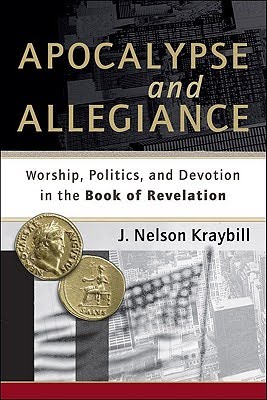
I've often remarked that I became a pacifist against my will by studying the book of Revelation. No doubt, one of the most formative books for me at that stage in my life was Richard Bauckham's fantastic work, The Theology of the Book of Revelation. This short book opened my eyes to John's Apocalypse and its theological and ethical implications. I've been hooked ever since. Learning how to read Revelation was extraordinarily illuminating not just for developing my theology but also in shaping the kind of person I want to be. Unfortunately, I have not been as successful in opening other people's eyes to the vision of God and his countercultural kingdom in Revelation. My marginal success in teaching Revelation with the same profound impact it had on me is due, in part, to my own insufficiency as a teacher. It is also, however, partially a result of the endless stream of interpretive waste that pollutes the minds of those who desire to understand and be transformed by the book of Revelation. As J. Nelson Kraybill insightfully puts it, "Because many Christians in North America live at relative ease in the heart of empire, it may be difficult for us to identify with the countercultural nature of worship in Revelation. We are tempted to the diversion of using Revelation as a horoscope for predicting the future rather than as a handbook for radical Christian living in the present" (190).
In a book that seeks to provide a profoundly practical and political reading of Revelation, J. Nelson Kraybill has given a gift to the church. Like Revelation itself, Kraybill's book is deeply rooted in the historical situation of the writer and intended reader, practically addressing issues ranging from peace in Palestine (51‒52), and persecution in Somalia (96) to healthcare reform in the United States (154‒155) and agricultural ethics in Japan (192‒193). Yet, again like the text of Revelation, this book will have a profound impact for years to come. It offers penetrating analysis of what worship, allegiance and faithfulness to the lamb look like in the real world of attractive empires, dangerous enemies and evil powers vying for the loyalty of humanity.
Kraybill brings academic credentials as well as international experience in teaching Revelation on the ground‒ in churches and Bible studies in Uruguay, Ireland, Korea and the United States (to name just a few). Both academic study and pastoral experience guide his book. Academically, one of the unique benefits of the book is the frequent use of photographs. By frequent, I mean almost one picture every two pages (over 80 pictures in a book under 200 pages). The pictures serve at least two vital functions, one academic and one pastoral. First, academically, the pictures root Revelation in the realia of the first century. So, in describing imperial worship, Kraybill includes a picture of the Roman Ara Pacis (Altar of Peace) erected by the Roman senate in honor of Caesar Augustus' military campaigns in the western expansion of the empire (erected in 9 BC; pgs 57‒59). One of the images depicted on the Ara Pacis shows the goddess Roma seated on top of the armor and weaponry of the then recently pacified peoples of Gaul and Spain. This is the Pax Romana (Peace of Rome) represented in the often quoted speech of a subdued British chieftain (ca. AD 83‒84), "To plunder butcher, steal, these things they misname empire: they make a desolation and call it peace" (Tacitus, Agricola 30; quoted on pg 59). This, according to Kraybill, is what the beast of Revelation 13 looks like. In addition to pictures of temples and archeological sites there is frequent reference to inscriptions and coins. Even in academic work these crucial historical studies taking into account epigraphic evidence are too rare.
Besides rooting Revelation firmly in the first century, the pictures, coins and inscriptions make the apocalypse more tangible to the average reader. This is the second and more pastoral function of the illustrations. Over and again, the illustrative material serves as a keen reminder that Revelation is not a book that has no reference or meaning in the real world. It is not a fantasy book, or a predictive timeline but a meaningful narrative picture of what it means for Christians to follow Christ in a very unchristian world.
Pastorally, this is a fantastic book. There are two features that make it useful in pastoral exegesis. First, each chapter concludes with reflection questions. These questions are not "tacked on" or obvious-easy questions like too many books hastily converted into Bible studies. The questions are actually quite helpful in provoking thought and applying Revelation. For example, after describing the heavy use of symbolism in Revelation in his first chapter, Kraybill suggests, "Make a list of icons, indexes, and symbols that you see today in politics, business, professions, or religion" (a very helpful exercise by the way) then he asks, "Do these have any effect on your attitudes or behavior?" I spent a week writing down icons, indexes and symbols in thinking about this question. I imagine I'll spend a lot longer reflecting on how they affect me. Or as another example, at the conclusion of chapter 5, "The Cosmic Throne Room," after describing the throne room scene of Revelation 4 in contrast with Roman imperial propaganda Kraybill asks, "What message do stamps and coins or other state-sponsored media in your country communicate? What stories of victory does your society retell to shape national identity and pride? Are there national holidays that Christians should refuse to celebrate or should mark with alternative celebrations?" (95). The reflection questions are worth the price of the book.
The second intentionally pastoral feature of Apocalypse and Allegiance is the final section of each chapter entitled, "Living the Vision." In these short, often only a page long, sections Kraybill gives a real life picture of how Christians throughout history have sought to live out the vision of John's Apocalypse in faithful ways. These examples are drawn from throughout history and are international. Kraybill doesn't limit the application of John's Apocalypse to these examples, but allows them to be exemplary of the kind of life John's vision ought to elicit in the faithful reader.
As should be obvious by now, I thoroughly enjoyed this book. I heartily recommend it and hope people read, and are challenged by it. Still, I had two disappointments with the book, one historical and one literary. In regard to history, the book lacked reference to the specific historical situation of Christians in Asia Minor. Though Revelation was clearly written to Christians in Asia Minor, most of the historical information Kraybill provides focuses on the Roman Empire as a whole or Jews in Palestine. Not until chapter 10, "Letters to Seven Churches" does Kraybill focus on the historical situation of the seven churches to which John wrote (157‒161). Then, the picture he gives in chapter 10 is broad enough to tell us little about the unique situation of Asia Minor Christians. Though Kraybill does give sufficient attention to the Pliny-Trajan correspondence (75‒79), it would have been helpful to focus on Asia Minor with the same historical acumen he treats the history of Rome and Jews in Palestine.
The praiseworthy attention Kraybill does give to the historical setting of Revelation sadly eclipses the much-needed attention that ought to have been given to the literary features of Revelation. Certainly, Kraybill mentions Revelation as an apocalyptic writing. He describes "apocalyptic" with the familiar metaphor of a political cartoon (42‒43). Also, he gives an apt description of Christian apocalyptic eschatology describing the overlapping of the ages (44‒45). Yet nothing in Apocalypse and Allegiance mentions the structure or big picture of Revelation. I am firmly convinced that a grasp of the literary connections within the book of Revelation are crucial for understanding it. Interpreting Revelation is one of the places where historian and literary critic have to come together and Kraybill's book fails to give full account of the literary repetition and cyclical structure. Only in his discussion of seals, trumpets and bowls does he make mention of the cyclical structure (119). The literary majesty of Revelation merits, in my opinion, more attention than Kraybill has given it.
Despite these two weaknesses, which after skimming back through the book seemed less pronounced than upon initial reading, Apocalypse and Allegiance is a brilliant book. I can only hope that it will open people's eyes to the vision of God and his kingdom found in John's apocalypse. Kraybill's book ought to bring us back to Revelation and experience it anew. Certainly he is correct, "Revelation is total immersion drama, meant more to be experienced than analyzed. It is valuable for us today to read the book aloud and occasionally to do so without stopping. We need to feel the flow, absorb the anguish and jubilation, observe the periods of silence, smell the incense, and bow in worship" (33).
Monday, May 3, 2010
apocalyptic made easy? – a review of craig hill’s In God’s Time

Any popular-level book on eschatology endorsed by the likes of Eugene Peterson, Luke Timothy Johnson, Jürgen Moltmann and John J. Collins merits some attention. Hill intended to write "a book for people who want to come to grips with what the Bible says about the future" (vii). The people he's addressing, he hopes, are the non-experts, laymen and pastors. His writing is lucid, compelling and sometimes downright poetic.
He begins the book with a brief chapter on the eschatological nature of the Christian faith. In the vein of Barth, Moltmann and Schweitzer Hill argues, "Christianity is irreducibly eschatological" (4). Accurately, and tellingly, he roots the eschatological outlook of Christianity in the resurrection of Jesus. Unfortunately, the eschatological perspective of the NT, he suggests, has been demythologized by the modern world. This isn't just a problem with moderns, but is noticeable in the pre-modern cosmology of the early Christians and rooted in a view of creation that Hill considers untenable. Still, Hill thinks eschatology is salvageable, as the core of Christian theology, but not without dealing with difficult questions.
He begins with a book that looks to be about eschatology, but the content is quite different. What he presents in the rest of the book is a history of religions approach to Christianity. So, his second chapter, "First things First: The Bible," is about the nature and authority of the Bible. Though starting out as a "fundamentalist teenager" Hill has moved on to a more nuanced faith. He writes, "More than twenty-five years and three theological degrees later, I am still a Christian. The core of my faith has not changed all that substantially, but my understanding of the Bible has" (14). I think he is correct in his movement beyond the language of "inerrancy" for understanding the nature of Biblical authority. Still, I was frustrated by his approach that leveled out the distinctiveness of the Bible in favor of finding out what is common to the Bible and other religions.
In his third chapter, Hill gives a brief but helpful account of biblical history. He focuses on prophesy and biblical revelation within the context of the Ancient world. He is correct in suggesting that "biblical prophecy as a whole is more concerned with influencing the present than with revealing the future" (33). His views are decidedly less conservative wholeheartedly embracing source criticism. Still, his presentation of the meaning and function of prophesy is helpful and a welcome alternative to the divination approach to eschatology found in the LaHaye's and Hagee's.
Chapter four, cheekily titled "Apocalypse Then," is an extended introduction to Jewish apocalyptic literature. Here is obviously dependent on John J. Collins and R.H. Charles, but still manages to present a helpful introduction to the apocalyptic material that is inaccessible to the average Bible reader.
After analyzing non-canonical Jewish apocalyptic, Hill looks specifically at the books of Daniel and Revelation. He insists that there is in fact very little difference between these apocalypses and the works of early Judaism that were not canonized. He mostly takes the party-line of contemporary scholarship (a late date for Daniel, and standard fare on Revelation). He does, however, occasionally take odd positions on some issues. I was dumbfounded by his odd suggestion that chapters 19 and 20 of Revelation are "two popular but competing scenarios, the first of an earthly and limited messianic reign and the second of a cosmic and eternal kingdom" (126). Though Hill is comfortable with that kind of bizarre discrepancy, I sincerely doubt John was and it seems like a genuine lack of effort in trying to explain what is happening in these important chapters. Overall, I think Hill's work on Revelation suffers significantly from failing to take account of the structure of Revelation.
Having spent time in apocalyptic, Hill moves to Jesus and eschatology. He argues for an eschatological Jesus in the same tradition as E.P. Sanders, N.T. Wright and Dale Allison Jr. This chapter is a very helpful and readable introduction to the evidence, which I find overwhelming, that Jesus was an eschatological prophet. Oddly, Hill spends very little time on the most significant eschatological discourse of Jesus (Mt 24.1‒51 || Mark 13.1‒37 || Luke 21.5‒36). It receives only about two and a half pages and Hill explains nothing but his lack of attention with the statement, "many of the apocalyptic elements of this chapter are unparalleled elsewhere in the Gospels. It is possible that Jesus said these things, but it seems just as likely (if not more so) that these verses reflect primarily the hopes, experiences, and concerns of believers a generation removed from Jesus" (165). Why he excludes the most apocalyptic material attributed to Jesus is nothing short of puzzling.
The last major chapter of Hill's book "The Once and Future Kingdom" is a discussion of eschatology mostly focused on the Pauline corpus. The whole discussion is framed in terms of the old "future" vs "realized" eschatology. He places the NT writings somewhere on the spectrum of "future" and "realized" and allows the two poles to serve as theological yardsticks. The description of theology as falling somewhere along that eschatological spectrum is a load to heavy to be borne by the simplistic categories (e.g. 190). Still, his account was a vivid and fresh reading the eschatological outlook of the NT as a whole.
I find it unlikely that In God's Time would be well received in evangelical circles, which despite the way Hill writes, are not the same as fundamentalists though they do sometimes overlap. While his writing is sometimes poetic, his argument is overly-simplified and sometimes oddly suspicious of the canonical texts. This is a helpful book for someone trying to communicate the meaning of apocalyptic eschatology to those without any frame of reference, but it should not be the only, or even primary introduction.